21 October 2026
Face Recognition vs Fingerprint Attendance in India
A practical comparison of the two most widely adopted biometric attendance technologies for Indian workplaces and how to choose.
21 October 2026
A practical comparison of the two most widely adopted biometric attendance technologies for Indian workplaces and how to choose.


Walk into an office, factory, or campus in India and you are likely to find one of two biometric attendance systems: fingerprint or face recognition.
Both offer an alternative to cards, PINs and manual registers. But they work differently, and the right choice depends on factors such as workforce conditions, environment, hygiene requirements, Aadhaar integration and deployment costs.
Here is how the two compare in practice.
Fingerprint attendance captures an employee's fingerprint and matches it against an enrolled template stored on the device or connected system. The employee places a finger on the sensor to authenticate.
Face recognition attendance uses a camera, and in some systems infrared or 3D sensing, to capture and match facial features against an enrolled template. Authentication is contactless.
Both link an attendance record to a verified identity. The practical differences come from how each technology performs in the workplace.
The operating environment matters. Fingerprint systems can face challenges with worn, dry or faint fingerprints, particularly among manual workers, agricultural workers and people whose hands are frequently exposed to dust, sunlight or physical labour. Sensor quality therefore matters considerably. Technologies such as thermal or multispectral sensing can improve fingerprint capture in difficult conditions.
Face recognition faces different challenges. Lighting, backlighting, camera positioning and movement can affect performance, particularly at factory entrances or semi-outdoor locations. Masks and other factors that obscure the face can also affect recognition.
The key point is that neither technology is automatically more accurate. Hardware quality and deployment conditions have a major influence on real-world performance.
For factories, campuses and large offices, attendance systems need to handle employee traffic efficiently during shift changes and peak arrival times.
Face recognition can reduce the physical interaction required from each employee. A well-configured system can identify someone as they approach the terminal without requiring them to stop and position a finger.
Fingerprint systems require a deliberate interaction, but a reliable scanner can still provide fast and consistent authentication.
In practice, exception rates matter as much as processing speed. A system that is slightly slower but rarely requires a second attempt may perform better than a theoretically faster system that frequently fails to recognise employees.
This is one of face recognition's clearest advantages.
Fingerprint terminals require employees to touch the same sensor throughout the day. This creates an additional cleaning requirement and may be a consideration in environments such as healthcare, food processing and pharmaceuticals.
Face recognition removes that shared contact point altogether.
For workplaces where contactless authentication is a priority, this can be an important factor in the decision.
Both technologies have known spoofing risks, and modern devices use different forms of liveness detection to address them.
Fingerprint devices such as the AST300 by Access Computech use liveness detection to distinguish a genuine finger from an artificial replica.
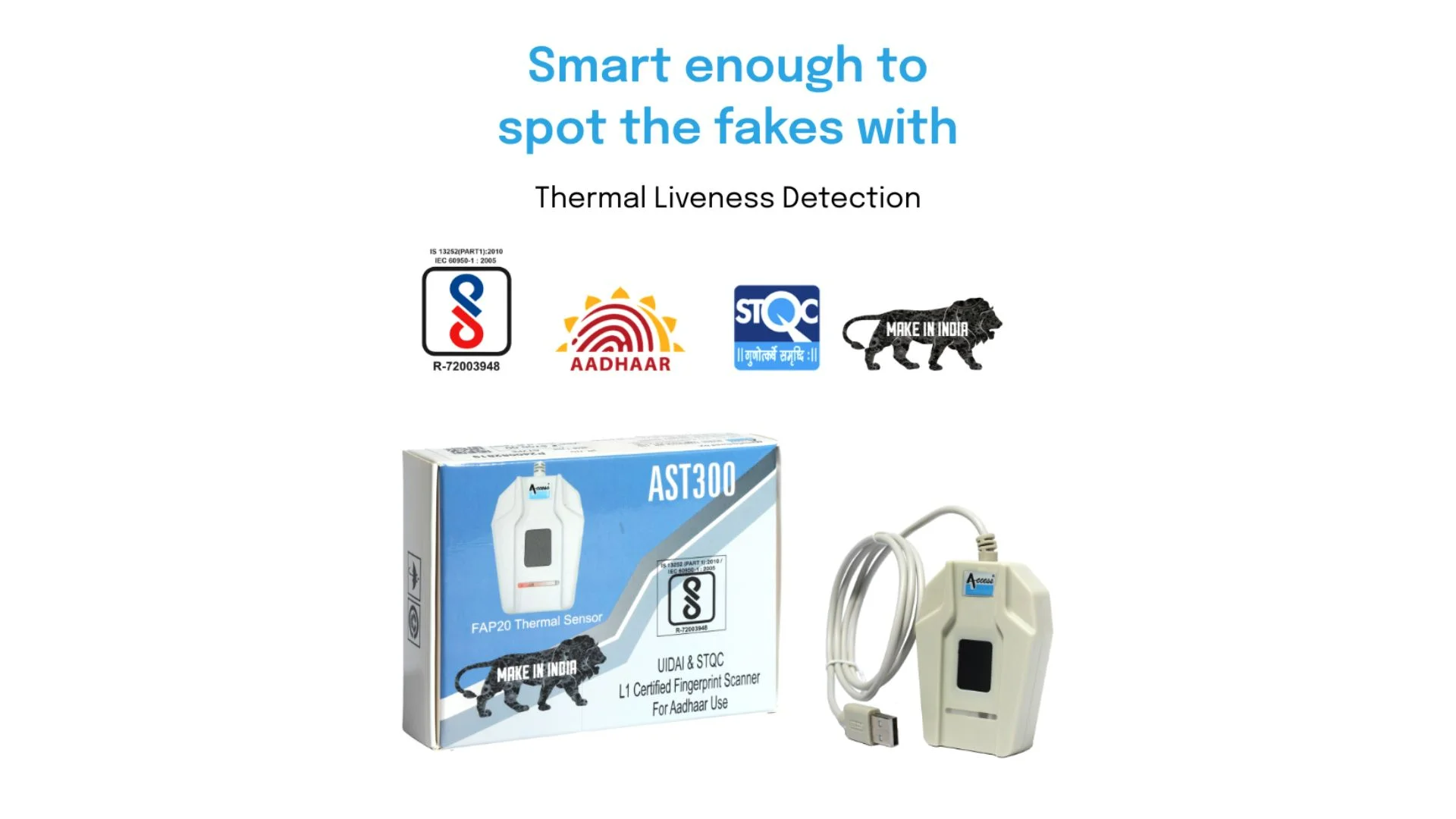
Face recognition systems may use infrared, depth sensing or other techniques to detect photographs, videos or masks rather than a live person.
For normal workplace attendance, the important question is therefore not simply fingerprint or face, but what anti-spoofing capabilities are built into the specific device being considered.
This is one of the most important differences in the Indian context.
Fingerprint biometrics has an established role in Aadhaar authentication, supported by UIDAI-certified devices and the Registered Device (RD) Service framework.
For organisations that require Aadhaar-based authentication, including applications such as AEBAS, this established ecosystem can make fingerprint-based devices the relevant option.
Explore Access Computech's certified biometric devices
Face recognition may be suitable for attendance systems that simply need to record employee presence without Aadhaar authentication. Where Aadhaar-based identity verification is a specific requirement, however, the available certification and authentication framework needs to be checked before selecting the technology.
At comparable quality levels, advanced face recognition terminals can cost more than fingerprint devices, particularly when they include infrared or 3D sensing and stronger liveness detection.
Face recognition also depends more heavily on installation conditions. Camera height, positioning, lighting and line of sight all need to be considered.
Fingerprint systems have their own maintenance requirements, including keeping the sensor clean and ensuring reliable fingerprint capture. But they generally have fewer environmental variables to manage.
The total cost should therefore include not just the device, but also installation, integration, maintenance and the likely rate of attendance exceptions.
There is no universal answer.
Face recognition may make more sense when:
Fingerprint may make more sense when:
The important question is not which technology is better in isolation. It is which system can provide reliable authentication for your workforce, in your environment, while meeting your operational and compliance requirements.
If you are evaluating biometric attendance for an Indian workplace, you can explore Access Computech's fingerprint attendance solutions or its range of certified biometric devices.