17 June 2026
One Hardware Partner For Your Entire Payment Network
Why banks, payment aggregators, and processors are moving toward a single certified hardware partner like Access Computech.

17 June 2026
Why banks, payment aggregators, and processors are moving toward a single certified hardware partner like Access Computech.


Running a payment terminal network at scale is not a hardware problem anymore, we’ve taken care of that. It is a coordination problem.
A bank or aggregator managing thousands of terminals across geographies, serving merchant acquiring, DBT disbursements, Micro ATM operations, and soundbox collections, is typically dealing with multiple hardware vendors, multiple software configurations, multiple support relationships, and multiple compliance tracks running simultaneously. Each one is manageable in isolation. Together, they create an operational overhead that grows quietly until it becomes a serious drag on deployment speed, support efficiency, and cost control.
The question most institutions eventually arrive at is whether there is a better way to structure the hardware layer. Access Computech's Banks and Aggregators service is built around that question.
Payment terminal deployments in India span a wide range of use cases: merchant POS at retail outlets, Aadhaar-enabled payment devices for BC agents, Micro ATM setups for cooperative and payments banks, soundbox solutions for small merchants, and government DBT delivery points. Each use case has its own device requirements, certification needs, and integration expectations.

When these are sourced from different vendors, the complexity multiplies very quickly. Different firmware update cycles. Different support escalation paths. Different integration documentation for each software stack. Different lead times and replacement processes when devices fail in the field.
For a bank or aggregator managing a large terminal network, this fragmentation has a real cost; in time, in support bandwidth, and in the inconsistency it introduces into deployments that need to run reliably across hundreds or thousands of endpoints.
Consolidating around a single hardware partner doesn't mean compromising on use-case coverage. It means sourcing devices that are built to serve multiple functions from the same certified platform, and working with a partner whose integration, support, and customisation capability spans that full range.
The same device that handles merchant acquiring at a retail point can support Micro ATM operations for a BC agent. The same platform that runs a DBT disbursement workflow at a government service centre can be configured for ticketing or soundbox applications. Device configurations, accessories, and software bundles can be tailored to meet specific project or RFP requirements without sourcing from a different vendor for each one.
For the institution managing the network, this means one procurement relationship, one support track, one integration framework, and one point of accountability when something needs to be resolved in the field.
At the infrastructure level, payment terminals operating in India's regulated financial ecosystem need to meet a specific set of certification requirements, L1 for Aadhaar-based biometric authentication, L3 for payment applications, and compliance with RBI and NPCI frameworks for the transaction types they support.
Sourcing certified hardware from a partner that understands these requirements, and has existing deployments across DBT programmes, Aadhaar-enabled payment services, and merchant acquiring networks, removes a layer of compliance risk from the institution's side. The devices arrive pre-certified and pre-integrated for the use cases they are meant to serve, rather than requiring the institution to navigate certification independently for each deployment.
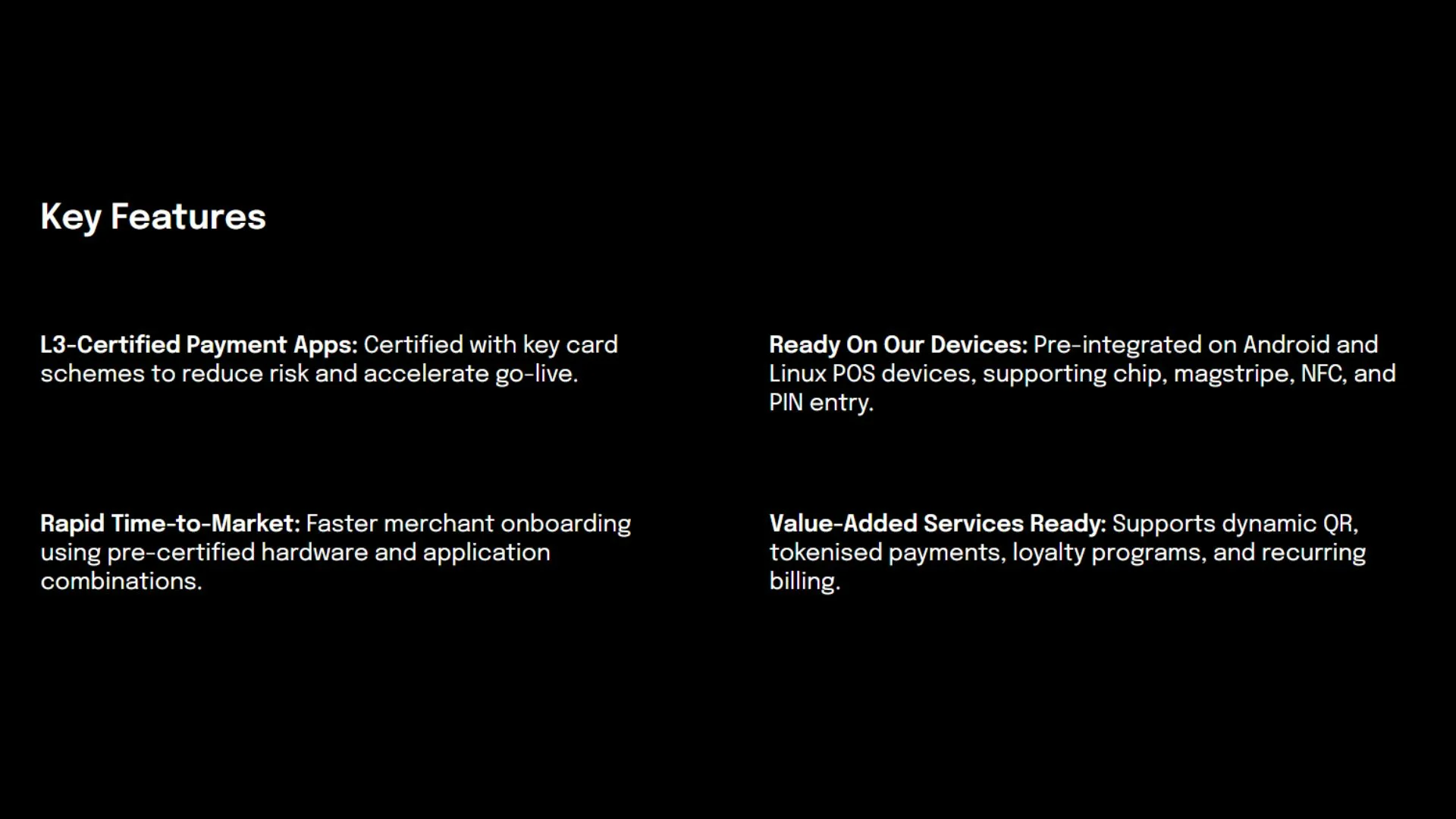
Access Computech's SmartPay and PayNext platforms support L3-certified payment applications, with device compatibility across chip, magstripe, NFC, and PIN entry, covering the transaction types that banks and aggregators need across their terminal networks.
Take a look at the key features of our L3-Certified payment applications, SmartPay and PayNext:
Hardware deployments at scale fail not just at procurement but at support. A terminal that goes offline at a merchant point, a BC agent location, or a DBT distribution centre represents a service disruption that the institution is accountable for, and the speed of resolution depends entirely on how the support infrastructure behind the hardware is set up.
A fragmented vendor network means fragmented support. An institution that has sourced devices from four different vendors is managing four different escalation paths, four different SLA frameworks, and four different replacement processes, often with no single partner taking end-to-end accountability for a deployment that spans all of them.
Consolidating around a single hardware partner such as Access Computech simplifies this directly. One support relationship, one escalation path, one partner with full context on every device type in the network and the integrations they are running on.
The institutions and aggregators that are scaling payment infrastructure efficiently in India are increasingly treating the hardware layer as a strategic partnership decision rather than a procurement one. The difference shows up over time, in deployment speed, support efficiency, and the operational consistency of a network that needs to work reliably every day.
If your institution is evaluating how to structure or scale its terminal network, Access Computech's Banks and Aggregators service is worth a conversation.