28 January 2026
How Controlled Entry Looks Different Across Indian Institutions
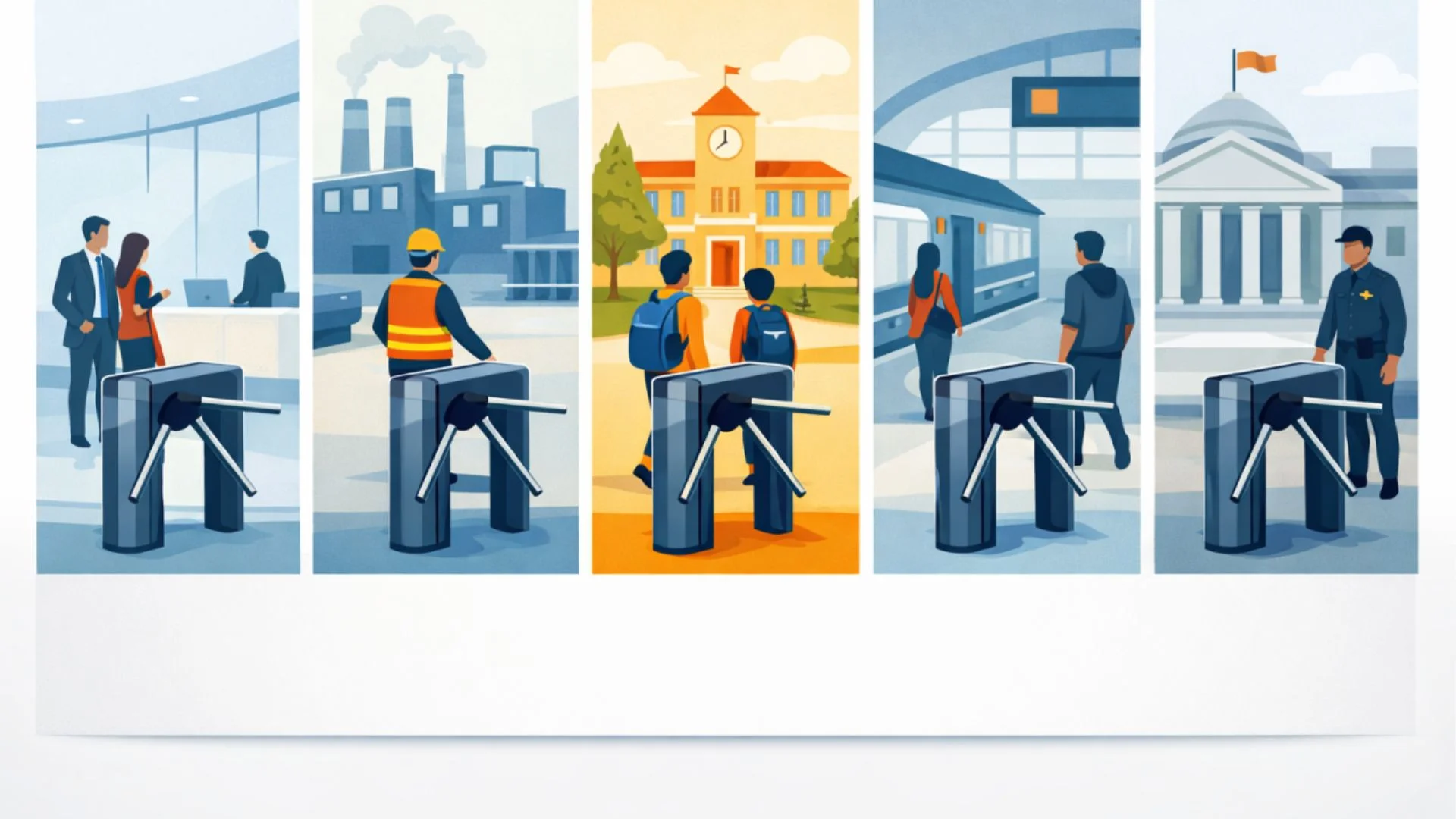
From corporate lobbies to factory gates and campuses, how Indian institutions implement controlled entry based on scale, risk and context
28 January 2026
From corporate lobbies to factory gates and campuses, how Indian institutions implement controlled entry based on scale, risk and context


When access control works well, most people don’t even notice it’s there. Doors open, queues move, people flow in the right direction, and no one feels watched or slowed down.
But step behind the scenes of any organisation or institution and you’ll find the same underlying question being asked in very different ways:
Who should be allowed in, where, and when, without turning everyday movement into friction?
This is where physical access control stops being a “security purchase” and starts becoming an operational decision.
In modern office environments, access control is less about restriction and more about rhythm.
Employees arrive in waves. Visitors come and go. Meetings overlap. Peak hours create pressure points at entry gates, especially in multi-tenant buildings and IT parks.
In these spaces, the challenge isn’t security theatre, it’s flow. Any system that slows people down becomes an irritant. Any manual intervention creates queues. Any inconsistency breaks trust.
Tripod turnstiles work here because they strike a balance: visible enough to signal controlled entry, but light enough to keep movement natural. Paired with cards or biometric authentication, they allow offices to maintain accountability without forcing people to “stop and prove themselves” every few steps.
The result is subtle but important: employees move smoothly, visitors are guided clearly, and security teams don’t need to constantly intervene.
Factories and industrial plants tell a very different story.
Here, access control isn’t about comfort, it’s about discipline, safety, and scale. Hundreds (sometimes thousands) of workers may enter or exit within narrow time windows. Contractors rotate frequently. Certain zones require restricted access due to machinery, materials, or compliance norms.
In these environments, loose access isn’t just a security issue, it’s a liability.
Tripod turnstiles help enforce structure during peak movement, especially at shift changes. They ensure one-person-at-a-time entry, prevent tailgating, and integrate cleanly with attendance and identity systems. This matters when payroll, safety audits, and regulatory reporting depend on accurate movement records.
What looks like a simple gate at the entrance often becomes the anchor point for attendance accuracy, contractor control, and internal accountability.
Schools and campuses operate on trust, but they still need boundaries.
Students arrive in large groups. Staff movement overlaps with visitors, parents, and vendors. Exam days, events, and assemblies change movement patterns overnight.
The challenge here is tone. Heavy-handed access systems feel out of place in learning environments. At the same time, completely open campuses invite chaos.
Tripod turnstiles work because they introduce order without intimidation. When combined with ID cards or biometric systems, they help institutions manage entry and exit during school hours, track staff attendance, and restrict access to sensitive areas, without turning campuses into fortresses.
Importantly, they reduce dependence on constant manual supervision. Security staff stop acting like gatekeepers and start acting like facilitators.
Airports, metro stations, terminals, and public venues face a different pressure altogether: volume.
Here, access control must work at speed, under stress, and often with minimal explanation. Any delay multiplies instantly. Any failure creates visible disruption.
Tripod turnstiles are commonly used in such environments because they are mechanically simple, fast to reset, and easy to understand. People instinctively know how to use them. There’s no learning curve, no confusion.
In high-footfall zones, that simplicity becomes a strength. It reduces error, keeps queues moving, and allows security systems to scale without adding manpower.
Government buildings sit at an uncomfortable intersection of openness and control.
They must remain accessible to citizens, yet accountable to regulations. Staff access must be tracked. Visitors must be guided. Sensitive departments require separation, all without creating friction or hostility.
Tripod turnstiles fit well in these settings because they formalise access without escalating tension. They establish a clear boundary between public and controlled spaces while remaining familiar and non-threatening.
When integrated with identity systems, they help create audit-ready movement logs, which is something increasingly important in compliance-heavy environments.
Across all these sectors, the underlying need is the same, controlled movement that doesn’t disrupt daily life.
That’s why access hardware like tripod turnstiles has endured even as software and authentication methods evolve. The form stays simple; the intelligence happens around it.
In real-world deployments, the success of access control isn’t measured by how advanced it looks, but by how quietly it works. When people stop thinking about the gate and focus on their day, the system is doing its job.
For organisations designing entry points today, the question is no longer “Do we need access control?”
It’s “Can our access control adapt to the many realities we operate in?”
And increasingly, that answer depends on choosing infrastructure that understands movement, not just security.